


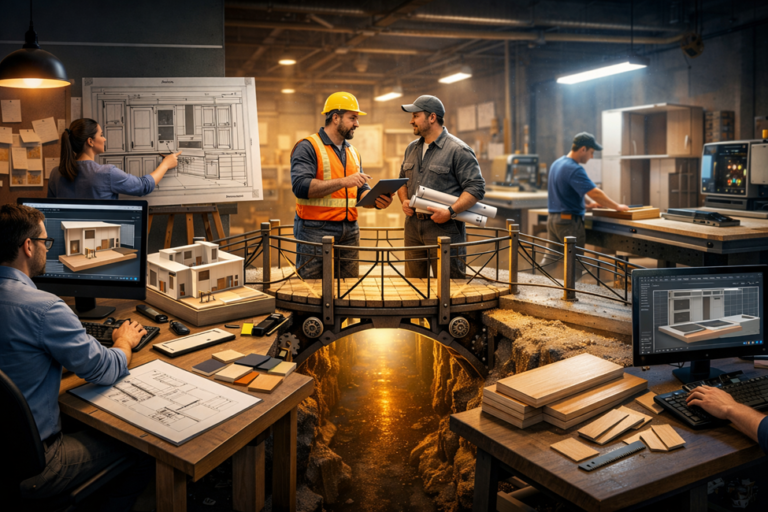
In today’s fast-paced construction and interior fit-out world, stunning designs alone are no longer enough. Projects succeed or fail based on how seamlessly ideas move from concept to fabrication. That’s where millwork engineers quietly become the unsung heroes of modern architecture and manufacturing.
From bespoke cabinetry and joinery to complex commercial interiors, millwork engineers sit at the intersection of design intent, technical feasibility, and manufacturing reality. They translate architectural creativity into buildable, cost-efficient, and production-ready solutions reducing errors, rework, and delays along the way.
As digital construction, BIM adoption, and offsite manufacturing accelerate across the UK, USA, and global markets, the role of millwork engineers has never been more critical.
So how exactly do they bridge the gap between design and manufacturing and why does it matter more than ever?
Let’s break it down.
What Do Millwork Engineers Actually Do?
At a glance, millwork engineering may sound like a niche discipline. In practice, it’s a highly technical role that blends CAD drafting, material science, fabrication logic, and manufacturing constraints.
Millwork engineers are responsible for converting architectural and interior design concepts into:
- Detailed shop drawings
- Precise fabrication-ready CAD files
- Material takeoffs and specifications
- CNC-compatible drawings and assemblies
They work closely with architects, interior designers, manufacturers, contractors, and installers to ensure everything fits literally and figuratively.
In short, millwork engineers make sure what’s designed can actually be built.
Why Is There Often a Gap Between Design and Manufacturing?
If you’ve ever been involved in a construction or interior project, you already know the pain points.
Designers focus on aesthetics, spatial experience, and creativity. Manufacturers focus on machinery limits, material behavior, tolerances, and cost efficiency. Without a technical bridge, misalignment is inevitable.
Common challenges include:
- Design details that are impossible or inefficient to manufacture
- Incomplete or ambiguous drawings
- Late-stage design changes causing production delays
- Cost overruns due to poor material planning
- Installation issues caused by dimensional conflicts
According to a McKinsey construction productivity report, poor coordination between design and execution can lead to up to 30% schedule delays and 20% cost overruns in complex construction projects.
This is precisely where millwork engineers step in.
How Do Millwork Engineers Translate Design Intent into Buildable Solutions?
1. They Decode Design Intent Without Killing Creativity
Millwork engineers don’t replace designers, they enable them.
Using advanced millwork design solutions, engineers interpret design drawings, 3D models, and specifications to understand:
- Functional requirements
- Aesthetic priorities
- Material preferences
- Tolerance flexibility
Their job is to preserve the design vision while adapting it to real-world manufacturing constraints often suggesting alternative joinery methods, materials, or assembly logic that achieve the same visual outcome more efficiently.
2. They Create Fabrication-Ready CAD and Shop Drawings
One of the most valuable contributions of millwork engineers is custom millwork drafting.
Unlike conceptual drawings, millwork shop drawings include:
- Exact dimensions and tolerances
- Joinery details
- Hardware placement
- Exploded views and sections
- CNC routing paths
These drawings act as a single source of truth for manufacturers, installers, and project managers.
According to a Dodge Construction Network study, projects using highly detailed shop drawings experience up to 42% fewer on-site clashes and RFIs.
That’s real time and money saved.
3. They Align CAD Data with Modern Manufacturing Technologies
Manufacturing isn’t what it used to be.
Today’s millwork facilities rely on:
- CNC machines
- Automated panel saws
- Nested-based manufacturing
- Digital inventory systems
Millwork engineers ensure CAD files are compatible with these systems reducing manual interpretation and minimizing production errors.
This alignment is especially important as Industry 4.0 principles reshape the manufacturing sector. A report by PwC notes that digitally integrated manufacturing workflows can improve production efficiency by up to 25%.
How Do Millwork Drafting Services Reduce Costly Errors?
Errors in millwork are expensive because mistakes often surface late, during fabrication or installation.
Professional millwork drafting services help prevent this by:
- Resolving clashes before production begins
- Standardizing drawing formats across teams
- Ensuring accurate material quantities
- Eliminating guesswork for shop-floor teams
For business owners and developers, this translates into:
- Fewer change orders
- Predictable timelines
- Improved budget control
In competitive UK and US markets, reliability is often the difference between profit and loss.
What Role Do Millwork Engineers Play in Design-to-Manufacture Collaboration?
4. They Act as Communication Translators
Millwork engineers speak multiple “languages”:
- Architectural design language
- CAD and technical drafting language
- Manufacturing and fabrication language
They act as intermediaries who ensure everyone is aligned, reducing miscommunication between creative and production teams.
This collaborative role becomes even more critical on international projects, where design teams, drafting teams, and manufacturers may be spread across different countries and time zones.
5. They Support Faster Project Turnarounds
Speed matters.
According to Autodesk’s construction industry report, digitally enabled workflows can reduce project delivery time by up to 20% when design and fabrication data are properly integrated.
Millwork engineers enable this speed by:
- Delivering ready-to-build drawings
- Supporting parallel design and production workflows
- Reducing back-and-forth revisions
For startups and fast-growing businesses, this agility can be a major competitive advantage.
What Are the Latest Trends Shaping Millwork Engineering?

6. BIM and Data-Driven Millwork Design
Building Information Modeling (BIM) is no longer optional in large UK and US projects.
Millwork engineers increasingly work within BIM environments to:
- Coordinate millwork with MEP and structural systems
- Extract accurate quantities
- Detect clashes early
This data-driven approach improves predictability and decision-making across the project lifecycle.
7. Sustainable and Material-Efficient Design
Sustainability is no longer a “nice to have.”
Millwork engineers contribute by:
- Optimizing panel layouts to reduce waste
- Selecting sustainable or FSC-certified materials
- Designing for disassembly and reuse
The UK Green Building Council reports that material optimization can reduce embodied carbon by up to 15% in interior fit-out projects.
8. Rise of Outsourced and Global Millwork Drafting Teams
With skilled labor shortages in the UK and USA, many firms now rely on offshore or hybrid teams for custom millwork drafting.
When managed correctly, outsourced millwork engineers offer:
- Faster turnaround times
- Cost efficiency
- Scalable expertise
This trend is reshaping how design and manufacturing teams collaborate globally.
What Opportunities Does This Create for Businesses and Decision-Makers?
For business owners, architects, and tech leaders, leveraging millwork engineers effectively means:
- Reduced project risk
- Higher-quality outcomes
- Better margins
- Stronger collaboration between design and production
As construction becomes more digital and data-driven, millwork engineers are no longer justsupport staff they are strategic contributors.
How Can You Successfully Integrate Millwork Engineers into Your Workflow?
Here are a few best practices:
- Involve millwork engineers early in the design phase
- Use standardized CAD and drawing protocols
- Encourage open collaboration between designers and fabricators
- Invest in experienced millwork drafting services with global exposure
Early alignment always costs less than late-stage corrections.
Final Thoughts:
In a world where design ambition is rising and manufacturing precision is non-negotiable, millwork engineers bridge the gap that technology alone cannot.
They connect creativity with constructability, vision with reality, and design with delivery.
For UK and global projects navigating tighter budgets, faster timelines, and higher expectations, partnering with experienced millwork engineers and robust millwork design solutions is no longer optional. It’s essential.
In the conclusion of any successful project, you’ll often find that the smoothest builds weren’t just well-designed, they were well-engineered. And increasingly, that engineering comes from specialized CAD-driven millwork expertise, including leading UK-based CAD design partners who understand both design nuance and manufacturing discipline.
FAQs
1: What is the role of millwork engineers in construction projects?
Millwork engineers convert architectural and interior designs into precise, fabrication-ready drawings and CAD files. They ensure that millwork elements like cabinetry, joinery, and custom interiors can be efficiently manufactured, installed, and delivered without costly errors.
2: How do millwork engineers bridge the gap between design and manufacturing?
Millwork engineers act as technical translators between designers and manufacturers. They align design intent with material behavior, machinery constraints, and installation requirements using detailed CAD drawings and millwork drafting services.
3: Why are millwork drafting services important for architects and developers?
Millwork drafting services reduce design conflicts, rework, and production delays by providing clear shop drawings, exact dimensions, and fabrication details helping architects and developers stay on budget and on schedule.
4: What is custom millwork drafting and when is it needed?
Custom millwork drafting involves creating tailored CAD drawings for unique or non-standard millwork components. It’s essential for bespoke furniture, commercial interiors, retail fit-outs, and high-end residential projects where standard details don’t apply.
5: How does CAD technology improve millwork design solutions?
Modern CAD tools allow millwork engineers to create accurate 2D and 3D models, coordinate with BIM workflows, optimize material usage, and generate CNC-ready files significantly improving manufacturing efficiency and reducing waste.
6: Are millwork engineers in demand in the UK and USA?
Yes. With rising adoption of BIM, offsite manufacturing, and customized interiors, demand for skilled millwork engineers and outsourced millwork drafting services is growing rapidly across the UK, USA, and global markets.
7: How can businesses benefit from outsourcing millwork drafting services?
Outsourcing millwork drafting services gives businesses access to specialized expertise, faster turnaround times, cost savings, and scalable resources especially valuable in regions facing skilled labor shortages.
